
Can Waste Heat Innovation Improve PUE?17 min read
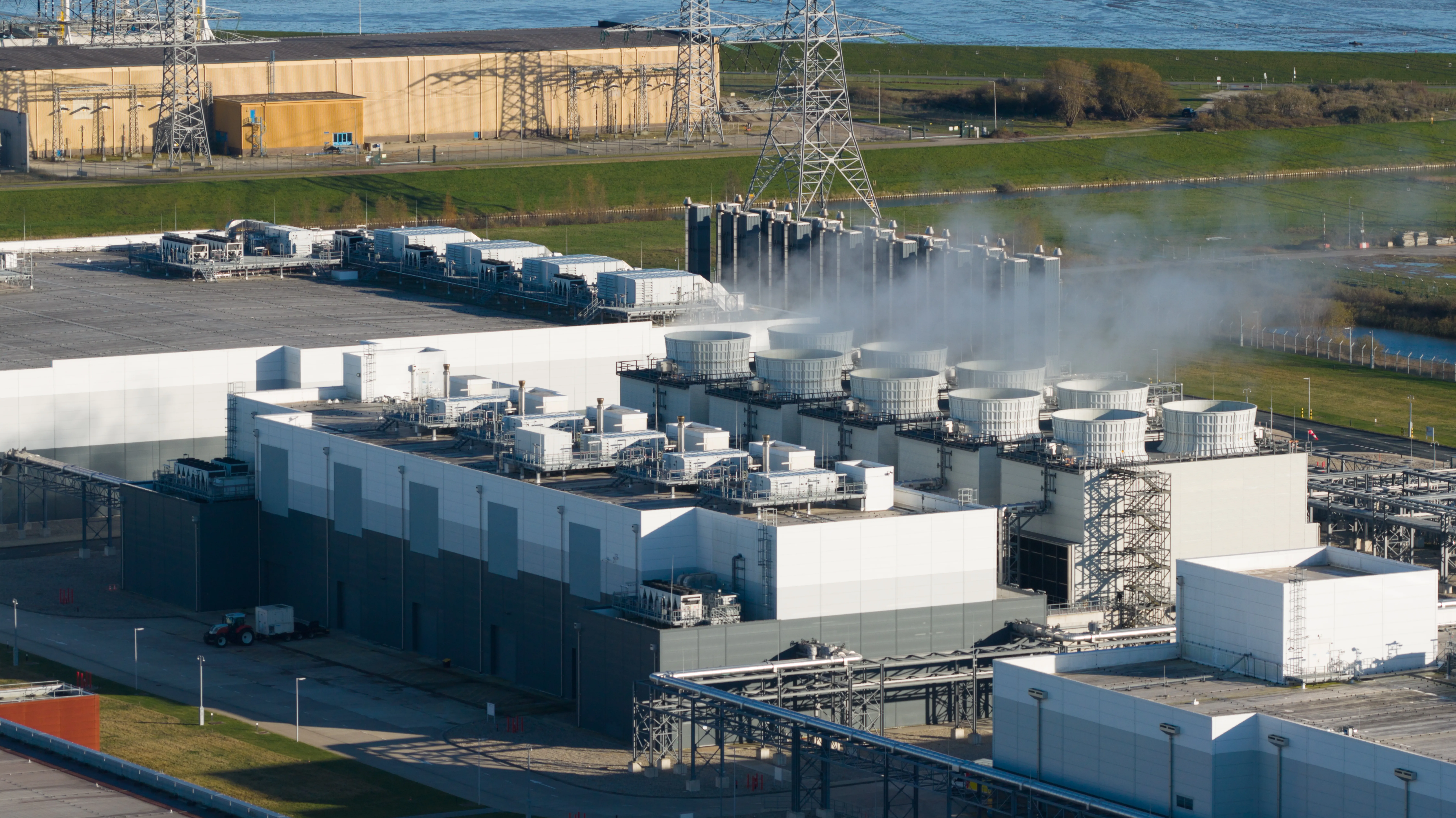
Waste heat recovery has been a staple of industry for many decades. Combined cycle gas turbine plants, for example, capture the exhaust heat from a gas turbine and use it to generate steam that drives another turbine. The result is a boost in efficiency from less than 40% to more than 60%. When waste heat is used in combined heat and power plants for such things as district heating, efficiency rates can go much higher.
Heat in most data centers, however, is rarely recovered as it is not at a high enough temperature to convert water into steam or operate other industrial processes. But that is changing across several fronts:
Milwaukee School of Engineering’s (MSOE) 65,000-square-foot computer science building includes a 1,500-square-foot data center that consumes over 60% of the total facility energy. Inside is a supercomputer consisting of two NVIDIA DGX H100s, each with eight NVIDIA H100 GPUs and connected by NVIDIA NVLink to provide 64 petaflops of A.I. performance. Its waste heat is integrated into the building’s mechanical, electrical, and plumbing infrastructure to provide heating in winter and cooling in summer. Rosie uses the same cooling system as the rest of the building during summer months to raise cooling efficiency. In winter, when the academic building no longer requires mechanical cooling, outside air cools Rosie via dedicated air-cooled rooftop condensers and integrated free-cooling circuits.
Another example: An Amazon Web Services (AWS) data center is providing heat to a suburb of Dublin, Ireland known as Tallaght. Recycled heat is being fed to 47,000 m² of public sector buildings, 3,000 m² of commercial space, and 135 apartments. AWS is offering its waste heat free of charge.
Waste Energy and PUE
How does this relate to Power Usage Effectiveness (PUE)? Places like Germany are severely limiting PUE in their data centers. The German Energy Efficiency Bill imposes 1.2 PUE limits on new facilities while mandating that any data center larger than 200 kW reuse 20% of its waste heat by 2028. Expect other countries and regions to begin adopting similar legislation.
Research is being conducted in the U.S. on how to lower PUE using waste heat. The Energy Systems Integration Facility (ESIF) at the National Renewable Energy Laboratory (NREL) combines the heating demands of labs and offices with its data center to achieve a PUE of 1.04. The 180,000-square-foot ESIF building in Golden, Colorado achieves this through a combination of design, warm-water liquid cooling, and waste heat recapture. Thus, ESIF only uses about 3% additional energy to cool the data center. Rack densities of 60 kW and more are cooled without mechanical refrigeration. Indirect evaporative cooling uses 75°F water for computer cooling, courtesy of evaporative cooling towers. Water circulates through heat exchangers in data center systems to capture waste heat. Once used to cool computing equipment, the water temperature rises to around 100°F and is reused to heat lab and office spaces within ESIF. If more heat is needed, it is drawn from the campus heating loop and, in turn, any surplus heat can be added back to the campus heating loop.
Innovation is moving ahead on many more fronts, all of which could be tied to reductions in data center PUE. TESS Energy Solutions has released Novacab 5 to tackle waste heat recycling at high capacity and with greater efficiency. It captures and stores ultra-low- and mid-temperature waste heat (-40°F to 450°F) using Synthetic Phase Change Materials (SPCMs) to generate electricity. These technologies store thermal energy, reduce cooling and heating loads, generate electricity, and cut down water consumption. A closed-loop process captures and uses the latent heat of the SPCMs to store large quantities of waste heat for use when it is needed. Then, the process is reversed to release stored energy. With more than 400 installations in commercial buildings and industrial facilities, the technology is now being implemented in the data center space. It integrates with conventional cooling, heating, and power generation systems that rely on water or refrigerants as the working fluid, including water-cooled chillers, cooling towers, and district heating systems.
Another example: Amherst College in Massachusetts upgraded its science center and data center cooling system to greatly reduce the amount of energy required during the summer, courtesy of a waste heat energy recovery system that works alongside its chiller system. A combination of a glycol loop and a MeeFog evaporative cooling system augments the electric chiller plant and lowers energy costs by up to one third. Exhaust air from the Science Center is fed through the glycol loop and is used to cool the outside air entering the building. The heat exchange efficiency of this system is increased by the addition of a MeeFog cooling system that precools the exhaust air by 10°F to 15°F through the evaporation of microfine fog droplets. Thus, the workload on the large centrifugal chillers used to cool the outside air is considerably reduced.
Real-time monitoring, data-driven optimization.
Immersive software, innovative sensors and expert thermal services to monitor,
manage, and maximize the power and cooling infrastructure for critical
data center environments.
Real-time monitoring, data-driven optimization.
Immersive software, innovative sensors and expert thermal services to monitor, manage, and maximize the power and cooling infrastructure for critical data center environments.

Drew Robb
Writing and Editing Consultant and Contractor
0 Comments