
How Baffles Improve Data Center Airflow and Lower Energy Costs16 min read
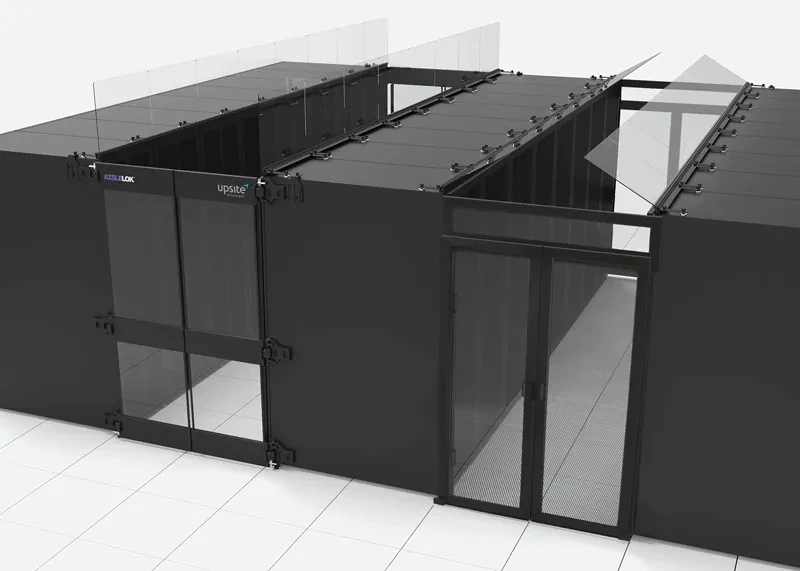
Study after study has demonstrated that cooling efficiency is badly impaired by exhaust air circulating over the top of racks and around the end-of-aisle cabinets. This mixing of exhaust and supply air raises IT equipment intake air temperatures and increases the potential for hot spots, downtime, and damaged equipment. To overcome this mixing requires colder supply temperatures and higher cooling unit fan speeds, both of which reduce cooling capacity and increase energy bills.
Full aisle containment is the most effective way of improving airflow management (AFM). It involves the installation of a full ceiling or chimney and doors that completely enclose the aisle. Full containment is the most effective way to separate cold and hot air and prevent it from mixing.
Partial containment is a great compromise for those that:
- Don’t yet have the budget for full containment
- Have fire suppression constraints that prevent full containment or make it very expensive
- Have cages or shifting customer requirements that require frequent changes to the room layout
Partial containment is easy to implement. All it takes is the installation of baffles on the top of the racks and doors at the ends of the aisle. Partial containment is effective for both hot and cold aisle containment.
At one data center, partial containment reduced the maximum server intake temperature by 7° F (3.9° C) and the number of hot spots in the row decreased from six to two. “The impact could be felt immediately,” said the data center manager. “We quickly saw that the baffles stopped the exhaust air from entering servers on top of the rack and prevented air from wrapping around the end-of-aisle cabinets. The drop in temperatures was immediate.”
Baffles are panels, approximately 19” tall and as wide as the racks, that are placed on top of the racks to either help retain cold air or block exhaust air recirculation into the hot aisle. They can either be at a 30-degree angle above horizontal, or vertical. Angled baffles are most commonly used on cold aisles. Vertical baffles are most commonly used on hot aisles, although they can also be used on cold aisles with overhead cooling.
They are deployed with no interruption to computer room operations. As they are attached magnetically, an entire row can be self-installed in minutes without the need for tools. These baffles can be moved and relocated as needed for access above the racks or relocation.
Not Quite as Good as Full Containment, But Almost
A detailed computational fluid dynamics (CFD) analysis of full versus partial containment was carried out to review the effectiveness of both solutions. The model used was of a 5,280 ft2 raised floor computer room. IT equipment inlet temperature, cooling unit fan speeds, airflow rates, air distribution effectiveness, and cooling costs were all studied. Compared to no containment of any kind, partial containment reduced the maximum cabinet inflow air temperature by 21.3° F (11.8°C). Full containment reduced the maximum cabinet inflow air temperature by an additional 0.5° F (0.3° C). For mid-row racks, partial containment reduced the maximum IT inlet temperature by 19.5° F (10.8° C) while full containment reduced it by an additional 3.7° F (2.1° C). Additionally, partial containment enabled a 30% reduction in cooling airflow. Full containment allowed for an additional 5% reduction in airflow. Partial containment enabled reductions in the total CRAH power of 65.7%, or 36.7 kW while full containment offered an additional 6.8% reduction beyond that of partial containment.
Finally, return on investment (ROI) showed that both solutions provided significant energy savings versus no containment. Due to the lower cost of baffles compared to full containment, its ROI was 13.5 months, about 10 months faster than full containment. In terms of energy savings, a 36.7 kW power reduction due to the use of partial containment equated to annual energy savings of $32,171. Full containment brought greater energy savings – an additional $3,349 over modular containment for a total of $35,520 in annual savings.
In this era of AI and soaring rack densities, data center efficiency is more important than ever. As the modern data center evolves, heavy investment is inescapable in many facilities. Where possible, full containment should be instituted. But where budgets are tight or other restrictions make it impractical, partial containment is an excellent way to increase efficiency, lower energy costs, and eliminate hot spots. All that is required is a few hours to deploy magnetically attached baffles along the tops of the racks, and likely aisle end doors.
The industry's easiest to install containment!
AisleLok® solutions are designed to enhance airflow management,
improve cooling efficiency and reduce energy costs.
The industry's easiest to install containment!
AisleLok® solutions are designed to enhance airflow management,
improve cooling efficiency and reduce energy costs.

Drew Robb
Writing and Editing Consultant and Contractor
0 Comments