
Is DC Power the Future of AI Data Centers?17 min read

Advances in graphics processing unit (GPU) technology are moving compute power to whole new realms. A GPU from two years ago, such as the NVIDIA RTX 40 series, can deliver substantially less processing power than current models. Factor in gains in software, and the actual gap is wider. NVIDIA’s Hopper H100/H200 and early Blackwell chips are being surpassed by the NVIDIA Rubin platform. Rubin has 336 billion transistors compared to around 80 billion for the H100. Other areas like memory and bandwidth have advanced at a similar rate. All of this adds up to as much as 10 times more agentic AI throughput per unit of energy compared to Blackwell.
That quantity of processing power is limited by many factors, chief among them the amount of electricity that can be channeled into the data center. Hyperscalers and data center developers, therefore, are giving electrical transmission and distribution plenty of attention and innovation input. They are reimagining electrical infrastructure.
One proposal is to replace the time-honored AC-DC-AC-DC conversions that are the current norm. This setup works but is complex and inefficient. Over time, it could be gradually replaced by all-DC configurations, beginning in some hyperscale data centers.
Vendors such as Delta, Vertiv, Schneider Electric, and Eaton have already introduced new DC designs. Their development is being driven by the hefty power demands of AI infrastructure. Advances in power electronics have enabled the elimination of some complexity inherent in traditional architecture. In the typical data center, power enters the facility as medium-voltage AC ranging from 1 kV to 35 kV. Transformers step it down to 480 V or 415 V, where it is converted to DC inside the uninterruptible power supply (UPS) for battery storage. Additional AC-DC conversions take place before low-voltage DC at around 54 V is fed to the IT equipment inside the data center. This is all done to ensure the incoming electricity is clean enough, stable enough, and of sufficient quality to be fed to sensitive servers.
Now factor in the latest GPUs and the servers being designed for AI processing. Their rack densities are getting so high that the copper busbars needed to feed them power are becoming too big, too unwieldy, and so difficult to bend that there isn’t room for them inside the racks. Current racks such as the NVIDIA GB200 NVL72 or NVIDIA GB300 NVL72 are already running into this problem. When next-generation racks come out in 2027, it has been calculated that the power shelves they need would require more than one entire cabinet. And when 1 MW racks appear, as much as 200 kg of copper busbar would be needed if 54 V remains the standard. Now multiply that by a hyperscale 1 GW data center facility. It could need up to 200,000 kg of copper.
That’s why 800 VDC makes sense. Higher voltages make it possible to lower the current. The benefits include a major reduction in the size of copper conductors, freeing up internal rack space for compute.
This can be accomplished by converting 13.8 kV AC grid power to 800 VDC at the data center perimeter. By doing so, the number of conversion steps, fans, power supply units (PSUs), and electrical components is reduced. As a result, system reliability can improve, heat dissipation can decrease, energy efficiency can increase, and electrical equipment footprints can be minimized.
NVIDIA calculations suggest that the change to 800 VDC in electrical distribution would bring about an 85% rise in the amount of power that can be transmitted through the same conductor size compared to 415 VAC distribution. The amount of copper needed would be reduced by 45%, end-to-end power efficiency could improve by up to 5%, and total cost of ownership for GW-scale facilities could drop by up to 30%.
Higher-voltage DC facilities already exist in China, including deployments associated with Baidu, China Telecom, and Alibaba. In the U.S., much of the development has focused on testing and emerging deployments with hyperscaler involvement. Meanwhile, NVIDIA, Google, and Microsoft are advancing 800 VDC through the Open Compute Project (OCP) as an open power architecture for next-generation AI factories. Already, more than 80 companies are building products across the ecosystem.
As AI workloads continue to push rack densities higher, 800 VDC offers a potential path to delivering more power with less infrastructure complexity. While widespread adoption will take time, the shift could play an important role in how the next generation of AI data centers is designed and operated.
Setting the standard for rack power reliability.
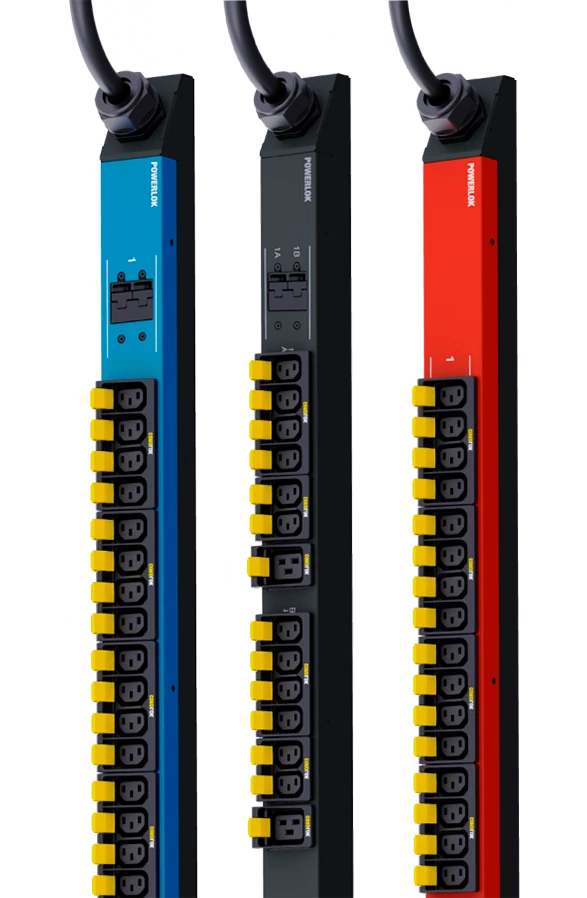 With automated soldering from line input to each receptacle,
PowerLok® eliminates all mechanical connections, making it 270%
less likely to fail than rack PDUs with mechanical terminations.
Setting the standard for rack power reliability.
With automated soldering from line input to each receptacle,
PowerLok® eliminates all mechanical connections, making it 270%
less likely to fail than rack PDUs with mechanical terminations.

Drew Robb
Writing and Editing Consultant and Contractor
0 Comments