
The 4 R’s of Airflow Management and Associated Best Practices15 min read
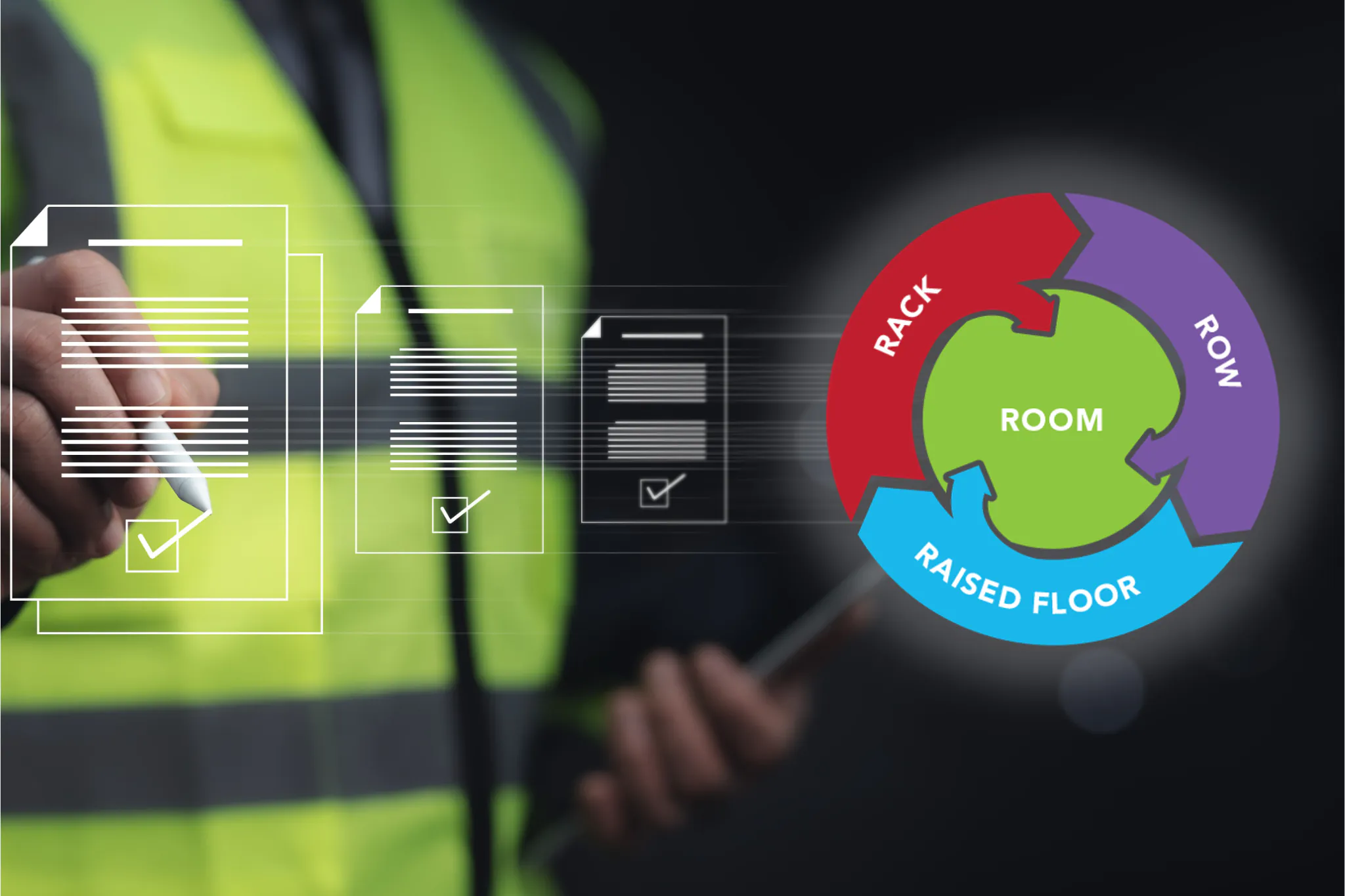
With so many variables affecting airflow within a data center, it can be daunting to know where to start and how to get the most out of airflow management improvements. The 4 R’s of Airflow Management™, developed by Upsite Technologies, is a holistic methodologyfor identifying and implementing changes to optimize the data center’s cooling infrastructure and realize energy savings.
The 4 R’s are: the Raised Floor, the Rack, the Row, and the Room.
After making AFM improvements at the Raised floor, the Rack, or the Row level, it is important to make adjustments to cooling unit controls at the Room level to optimize the cooling infrastructure and realize energy savings. This is referred to as cooling optimization.
Rack Airflow Management

Managing airflow through the vertical plane across the face of IT equipment intakes is “Rack AFM”. Sealing the open space of a rack often provides the greatest return on investment of any AFM effort, both in the ability to reduce hot spots and the ability to reduce energy consumption.
Rack AFM Best Practices:
- Install blanking panels in every open U space
- Seal the space between mounting rails and sides of cabinets
- Identify IT equipment mounted to the back rails, such as switches that do not have ducted inlets to the face of the cold aisle, and correct with AFM products (SwitchFix)
- Identify IT equipment facing backwards, inlets facing the hot aisle and exhaust blowing into the cold aisle, and rotate equipment if possible
Raised Floor Airflow Management

Managing airflow through the horizontal plane of the raised floor is “Raised Floor AFM”. There are two aspects to raised floor AFM. The first, is sealing all openings in the raised floor other than supply tiles. The second, is managing the type, location, and number of supply tiles. Raised floor AFM ensures that the cooling capacity in the room is properly delivered to the cold aisle. Without good raised floor AFM, the number of customers and/or the amount of customer heat load that can be effectively cooled will be compromised.
Raised Floor AFM Best Practices:
- Seal cable openings with brush grommets
- Seal openings around the perimeter of the room
- Seal openings in the perimeter walls below the raised floor or around partitions
- Make sure all supply tiles are properly located in front of IT equipment and remove any tiles that are not supplying cooling air to IT equipment
- Ensure supply tiles are the appropriate size in terms of % open area
Row Airflow Management
 Improving cold aisle and hot aisle separation at the row level is “Row AFM”. After improving AFM at the rack and raised floor levels, evaluating the air distribution in rows is the next step in AFM and reducing energy consumption. This generally involves installing doors on either the ends of hot or cold aisles and baffles or a full roof over the aisle.
Row AFM Best Practices:
- Block open spaces underneath racks to prevent air flowing under the cabinets
- Seal spaces in cabinet rows where there are missing cabinets or gaps between cabinets
- Install aisle end doors on either the hot or cold aisles
- Install top-of-rack containment (partial or full) on either the hot or cold aisles
Room Airflow Management
Changes at the room level are required to realize the benefits of implementing the AFM improvements listed above. “Room AFM” refers to optimization of the cooling infrastructure and is the only way to realize energy savings from AFM improvements made at the Rack, Raised Floor, and Row levels. This is referred to as cooling optimization.
Room AFM Best Practices:
- Raising cooling unit air temperature set points as high as possible without exceeding the maximum allowable IT equipment intake air temperature
- Reduce fan speeds for units with variable frequency drives (VFD) as much as possible without exceeding the maximum allowable IT equipment intake air temperature
- Expand the allowable relative humidity (Rh) band to prevent cooling units from “fighting” with each other (wasting energy by one unit trying to dehumidify while another unit tries to humidify)
- Turn off excess cooling units when possible
Real-time monitoring, data-driven optimization.
Immersive software, innovative sensors and expert thermal services to monitor,
manage, and maximize the power and cooling infrastructure for critical
data center environments.
Real-time monitoring, data-driven optimization.
Immersive software, innovative sensors and expert thermal services to monitor, manage, and maximize the power and cooling infrastructure for critical data center environments.

0 Comments