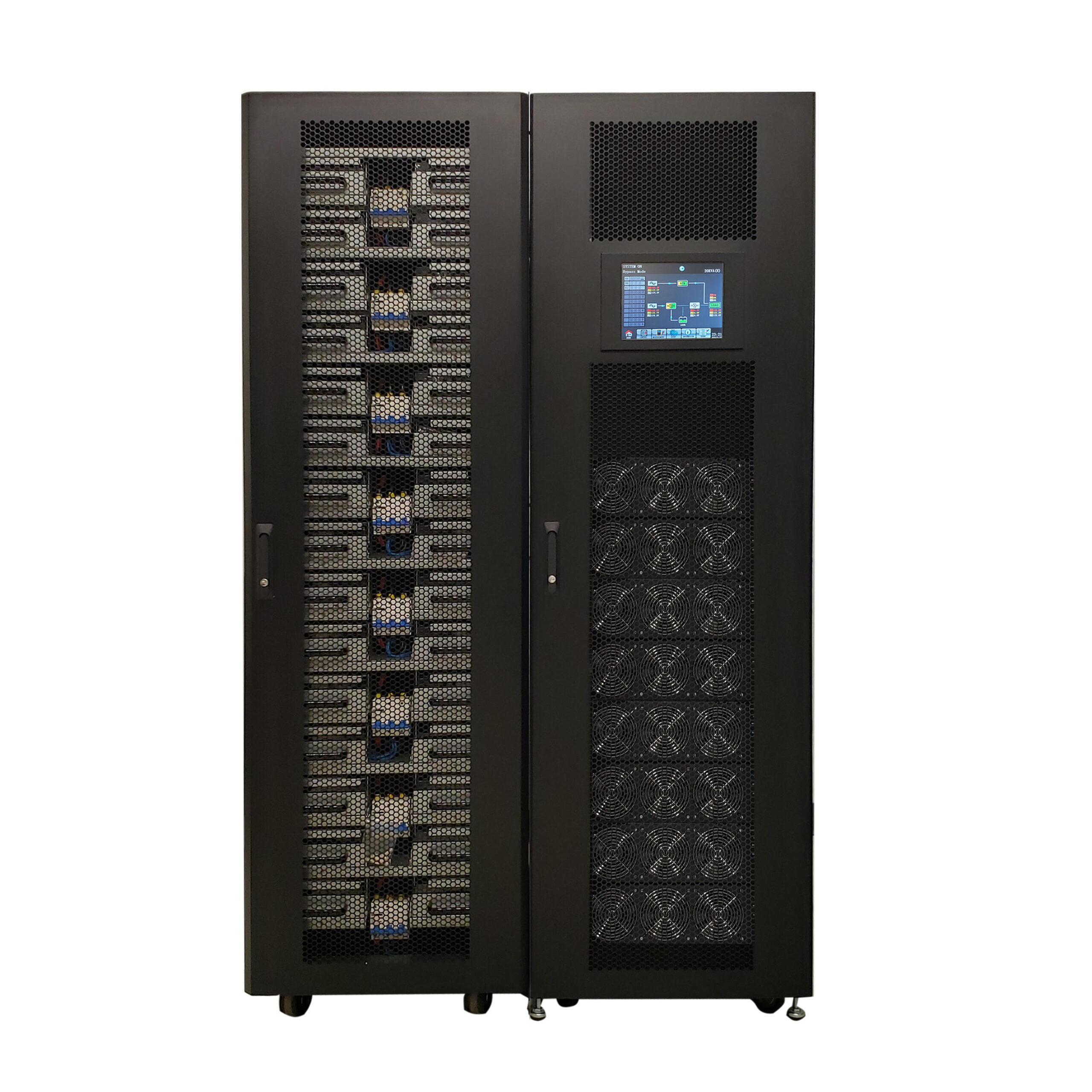
- Single-Cabinet High-Density Consolidation: Integrates hot-swappable power modules (up to four 15 kW or 20 kW modules), up to 16 internal VRLA battery modules, a modular static switch, and a front maintenance bypass into a single 208/120V cabinet.
- Modular N+1 Redundancy & Hot-Swappable Capacity: Allows hot-swappable capacity scaling from 15 kW up to 80 kW at unity power factor (kW = kVA), with support for N+1 redundant power module configurations up to 60 kW.
- Front-Accessible Maintenance Bypass & Backplane Batteries: Features a front-mounted maintenance bypass switch and backplane-connected battery modules, eliminating the need for rear service access.
- Enhanced Diagnostics via 10-Inch Touchscreen LCD: Includes a full-color 10-inch graphic touchscreen panel providing real-time system status, alarm notifications, and power monitoring.
- Top-Feed Cable Entry & Flexible Input Design: Equipped with top-feed input and output cable routing alongside dual- or single-input electrical configuration options.
- Drastically Reduces Electrical Room Footprint: Replaces traditional multi-cabinet 60–100 kW UPS setups by consolidating power, battery storage, and bypass into a single cabinet—saving valuable floor space in cramped data centers and electrical rooms.
- Maximum Real-Power Usability & Energy Savings: Unity power factor delivers 100% usable real capacity without wattage derating, while high operating efficiency (up to 94% online / 98% ECO mode) minimizes utility bills and cooling demands.
- Uninterrupted Availability & Zero-Downtime Expansion: N+1 redundancy protects mission-critical loads if an individual module fails, while hot-swappable power and battery modules allow IT staff to scale capacity or perform maintenance without taking connected loads offline.
- Faster Servicing & Reduced Installation Costs: The front-mounted maintenance bypass and backplane battery design streamline routine maintenance, while top-feed cable entry drastically simplifies cabling work in facility electrical rooms.
- Phased Capital Expenditure (“Pay-as-You-Grow”): Modular scalability lets facilities deploy only the power and battery modules needed today and add capacity up to 80 kW as operational demand grows, avoiding large upfront capital investments.